Showing posts with label Labour Party. Show all posts

Tuesday, 17 January 2023

Tribalism: A Fair Warning


Well, I am once again a member of the yellow political tribe, after rejoining the Liberal Democrats last month. This has led me to think a lot about the place of political parties and the impact of tribalism within democracy. In this article, I discuss tribalism and issue a warning to everyone who cares about a viable functioning liberal democracy.

I have been a member of a political party for most of my adult life. For most of that time I have been a member of the Liberal Democrats and I was briefly a member of the Green Party; it is safe to say that party affiliation has always been an important part of my political identity. As is the adversarial nature of British politics, I have occasionally fallen foul of petty tribalism myself and petty point scoring. Social media (especially Twitter) seems to exacerbate tribalist temptations. On reflection, what did my tribalism achieve? Arguably, very little, save a political ego boost. So, in part, this article is a warning to myself, as much as it is a warning to anyone else.

Liberals and progressives of all kinds have often critiqued nationalism and egoism for breeding hatred and selfishness. Tribalism is merely nationalism extrapolated to the level of political parties. It breeds mistrust, even hatred, towards other people for no other reason than that they are a member of another political tribe. The tribal mentality informs nationalism just as much as it informs party tribalism. It also informs the group egoism and privilege that informs many parties, especially parties which often exercise political power. The defence of tribe is as powerful within political discourse as it is dangerous.

Tribalism is poison in the veins of any liberal democracy. While competition between parties is vital to any multi-party democracy, tribalist mistrust and selfishness is corrosive to the political culture of any liberal democracy. If left unchecked, it can breed irreconcilable differences, differences that in time can breed extremism which can endanger a viable liberal democracy. It also breeds cynicism and mistrust towards politics and democracy amongst the general population, further making politics susceptible to forms of political extremism.

A liberal democracy can only survive as long as there is a degree of cooperation between its major political actors and a democratic consensus between the major political parties. No democracy can endure with irreconcilable differences with swathes of the population no longer trusting elected politicians or the institutions of democracy. Liberal democracy rests on its political actors being driven by the pursuit of the common good and the public interest. If they allow tribalism and the vested interest to get in the way of the common good and the public interest, it will undermine the very foundations upon which a healthy democracy rests.

In a true democracy, all citizens are political actors. Therefore, all citizens are responsible for their political conduct and are responsible for the type of democracy their conduct leads to. If you want a democracy that rests upon hate, cynicism and tribe; be hateful, cynical and tribal. If you want to democracy that is kind, cooperative and respectful; be kind, cooperative and respectful yourself. As free, rational political actors, we have political agency. We are responsible for our political actions, and we are responsible for the type of democracy that we create.

No political party has a monopoly on political wisdom or good policies. All democratic parties can learn from one another. Despite now being a Liberal Democrat again, I still admire other progressive parties. I deeply admire the Green Party (which I was briefly a member of). It has a vital role to play in combating the climate emergency and in campaigning for climate justice. Caroline Lucas continues to be my favourite non-Lib Dem MP. In Zack Polanski, the Greens have an exceptional Deputy Leader. I also admire progressive politicians across the Labour Party, as well as Labour’s sister party, the Co-operative Party. I have even admired moderate Conservatives in the past, such as Ken Clarke, Heidi Allen and Sarah Wollaston (the latter two subsequently defected to the Liberal Democrats). I take inspiration from the Attlee and Wilson Labour governments of the past, as well as from the Macmillan Conservative government.

The first past the post voting system breeds adversarial politics through its winner takes all approach to elections. This helps to ingrain a zero-sum game approach within British politics. I believe that moving to proportional representation (preferably the single transferable vote) would lead to a strengthening of British political culture and would equally create a politics that is kinder, more collegial and more respectful. PR would naturally result in parties having to work together more often. You cannot be a supporter of multi-party liberal democracy and believe in a narrow range of viable political opinion. In a true liberal democracy, political opinion should be as wide as possible, with the exception of parties and political actors that advocate hatred towards minorities or violence. No liberal democracy should ever tolerate intolerance, for that has an even bigger corrosive impact on the foundations of liberal democracy than any form of party tribalism.

British politics needs to be more pluralistic and parties need to cooperate more. This is especially the case for progressive parties. I have long advocated for Labour, the Liberal Democrats and the Greens to work together when and wherever possible. To this end, it is vital that at the next general election, all three parties campaign tactically to focus their resources on constituencies where they are best placed to unseat incumbent Tories. This must also be accompanied by the most sophisticated and wide-ranging tactical voting campaign ever seen in a British election. Tactical voting should actively be encouraged by all progressive parties due to the shortcomings of first past the post. It is also essential that all the progressive parties stand on a common platform of proportional representation, Lords reform, ending the climate emergency, opposing austerity and saving the NHS.

Let us be kinder and more respectful to our fellow democrats. While legitimate criticism and policy disagreements are essential for democratic political discourse, let us never stop trying to find the common ground between the parties. Let us strive for consensus and the common ground with the same righteous energy that we call out injustice, hatred and discrimination. Democracy ultimately rests upon a just and fair overlapping consensus between citizens and major political actors. Let’s build bridges of fairness, not walls of tribal intolerance.

In a liberal democracy, we have the freedom to speak, but that implicitly means that we have the freedom (even the responsibility) to listen to one another. In our social media age, we have mastered the prior and neglected the latter. A viable liberal democracy requires debate, but it equally requires dialogue. We must not lose sight of this. If you want a build a healthier, stronger, kinder democracy, then spend more time finding out what we have in common with each other politically, than on highlighting what we disagree on. It’s that simple!

Tuesday, 9 August 2022

What is the Point of Starmer’s Labour?

(Photo credit: Sky News)


Britain is facing manifold social and economic crises unlike anything seen in decades. The cost of living crisis fuelled by rising inflation and years of austerity is undermining the living standards of working class and lower middle-class people. Millions are facing fuel poverty in the coming months as energy bills skyrocket. The NHS is struggling to cope and thousands lack access to an NHS dentist. The Bank of England has forecast that the country is heading into recession. Trade unions across multiple sectors of the economy are preparing for strike action as their members face real terms pay cuts in the face of high inflation levels. There is even speculation about the need for blackouts in January. All the while, the government is paralysed as the Conservatives wait to elect their new Prime Minister.


The situation facing Britain after 12 years of Tory-led government is truly dire. While Labour’s former Prime Minister Gordon Brown has warned that Britain is facing a “winter of dire poverty” and has called for Parliament to be recalled and for there to be an emergency budget. Brown gave his endorsement (along with several charities, faith groups and organisations) to a report highlighting the impact of the cost of living crisis, and called for the government to “take immediate action to bridge the shortfall [in people’s incomes] and ensure families have enough to live.” His position and the report were endorsed by Labour’s sister party, the Co-operative Party, but curiously the Labour Leadership has (at the time of writing) yet to clearly endorse it, despite it being a leading news story. Even the Liberal Democrats have called for October’s expected rise in the energy price cap to be scrapped.


Labour has so far struggled to get a handle on the many social and economic crises and Keir Starmer was forced to U-turn on his initial opposition to allowing Labour frontbenches to join picket lines. Labour under Starmer has yet to consolidate a clear political identity and narrative for itself. It lacks a core mission and its concrete policy proposals have been few and far between. It is lacking the red meat of social democracy, at a time when it is desperately needed. All of this leads to the question as to what is the point of Starmer’s Labour?


The instant answer is to replace the Conservatives as the party of government. There can be no doubt that a Keir Starmer led government would be a significant improvement on the current Tory government and the two candidates vying to replace Boris Johnson. I personally hope for a Labour-led government after the next general election, preferably with some form of power-sharing agreement with the Lib Dems and the Greens, along with a commitment to introducing proportional representation. Britain is crying out for a progressive government.


But Labour needs to be careful. This is not the 1990s. In fact, politically the 2020s is likely to be much closer to the 1970s, and perhaps even the 1930s. Although Labour can point to the recent success with the Wakefield by-election, it has yet to pull ahead considerably in front of the Conservatives in the opinion polls. Starmer is not polling leads as consistently high as Ed Miliband was a decade ago, let alone Tony Blair in the 1990s. A poll last month found that 43% of Labour supporters did not know what Keir Starmer stood for. This is a problem Labour must address urgently.


Labour needs ideas, and radical big ideas at that. Ideas that will enthuse voters. Ideas that Labour has the courage to argue for and campaign for. It was therefore disheartening to see Labour’s Shadow Chancellor, Rachel Reeves, appear to rule out a future Labour government supporting re-nationalisation. This follows Starmer’s previous rejection of universal basic income (UBI) during the pandemic.


Labour must not aim to become the last defenders of a failed consensus, bereft of ideas or a viable progressive alternative in the face of an immense crisis. This is what doomed the Labour government of Ramsay MacDonald in the late 1920s and early 1930s, as well as the Labour government of Harold Wilson and James Callaghan in the 1970s. In both instances, Labour was annihilated at the following general election and Britain had Conservative or Conservative dominated governments for over a decade.


It may sound like a contradiction, but in order to be pragmatic, Starmer’s Labour needs to be radical. There is nothing pragmatic about ruling out potential solutions to the cost of living crisis, something that public ownership or UBI could help to deliver. To rule something out based on pre-existing orthodoxy is the very nature of an ideological position. Labour must keep its policy options open. True pragmatism is not about bland banality, ruthless centrism or compromise for the sake of compromising, it is about proposing solutions to the problems of the day, often in the face of orthodox ideological certainties.


To get a flavour of what I mean, consider this quote from the Beveridge Report of the social liberal founder of the welfare state, William Beveridge; “A revolutionary moment in the world's history is a time for revolutions, not for patching”. This is a statement which is as radical as it is pragmatic. Beveridge was confronted by the giant social evils of the early 1940s, and he and his committee in the Beveridge Report of 1942, proposed a radical new model of social welfare provision in order to address them. Labour (and the Lib Dems) today, require both Beveridge’s radicalism and his willingness to disregard old certainties in the face of a historic social crisis.


So, what is the point of Starmer’s Labour? Inevitably, this shall be determined by events, most of which will be out of the Labour Party’s control. In fairness to Starmer, Britain is still more than two years away from a general election. However, it is already clear that the cost of living crisis, along with the many other crises that Britain faces, will be the defining issues in British politics for the foreseeable future. The point of Starmer’s Labour therefore will be to solve these crises.


Starmer admittedly has a very difficult political tightrope to walk. But should Starmer win power, he will face the worst inheritance of any incoming government in decades. The same was true when the government of Clement Attlee took power in 1945. In part due to the ideas of the Beveridge Report, Labour was able to establish a post-war welfare consensus which lasted until the late 1970s. Britain once again faces a “revolutionary moment” in its history. Will Labour be intellectually bankrupt and torn apart as it was in the 1930s and 1970s, or will it again summon the courage to envision a “New Jerusalem”, to cast old certainties aside and to slay society’s giant evils, as it did in the 1940s?


I very much hope for the sake of our country that it is the latter. I want to see the back of this wretched, corrupt and heartless Conservative government. But even more than that, I want to see someone in power with the courage to propose and enact solutions to the country’s many social and economic crises. It must be the point of Starmer’s Labour to do exactly that.

Only a Just Society can Defeat Hard Right Populism

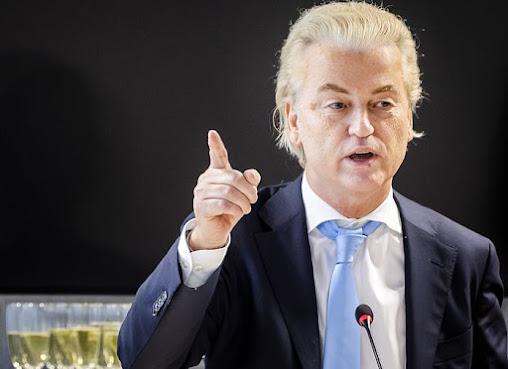
Geert Wilders following the Dutch General Election last November. Photo Credit: Remko de Waal/AFP/Getty Images.     F ellow centre-lef...