Showing posts with label Social Democracy. Show all posts

Tuesday, 9 August 2022

What is the Point of Starmer’s Labour?

(Photo credit: Sky News)


Britain is facing manifold social and economic crises unlike anything seen in decades. The cost of living crisis fuelled by rising inflation and years of austerity is undermining the living standards of working class and lower middle-class people. Millions are facing fuel poverty in the coming months as energy bills skyrocket. The NHS is struggling to cope and thousands lack access to an NHS dentist. The Bank of England has forecast that the country is heading into recession. Trade unions across multiple sectors of the economy are preparing for strike action as their members face real terms pay cuts in the face of high inflation levels. There is even speculation about the need for blackouts in January. All the while, the government is paralysed as the Conservatives wait to elect their new Prime Minister.


The situation facing Britain after 12 years of Tory-led government is truly dire. While Labour’s former Prime Minister Gordon Brown has warned that Britain is facing a “winter of dire poverty” and has called for Parliament to be recalled and for there to be an emergency budget. Brown gave his endorsement (along with several charities, faith groups and organisations) to a report highlighting the impact of the cost of living crisis, and called for the government to “take immediate action to bridge the shortfall [in people’s incomes] and ensure families have enough to live.” His position and the report were endorsed by Labour’s sister party, the Co-operative Party, but curiously the Labour Leadership has (at the time of writing) yet to clearly endorse it, despite it being a leading news story. Even the Liberal Democrats have called for October’s expected rise in the energy price cap to be scrapped.


Labour has so far struggled to get a handle on the many social and economic crises and Keir Starmer was forced to U-turn on his initial opposition to allowing Labour frontbenches to join picket lines. Labour under Starmer has yet to consolidate a clear political identity and narrative for itself. It lacks a core mission and its concrete policy proposals have been few and far between. It is lacking the red meat of social democracy, at a time when it is desperately needed. All of this leads to the question as to what is the point of Starmer’s Labour?


The instant answer is to replace the Conservatives as the party of government. There can be no doubt that a Keir Starmer led government would be a significant improvement on the current Tory government and the two candidates vying to replace Boris Johnson. I personally hope for a Labour-led government after the next general election, preferably with some form of power-sharing agreement with the Lib Dems and the Greens, along with a commitment to introducing proportional representation. Britain is crying out for a progressive government.


But Labour needs to be careful. This is not the 1990s. In fact, politically the 2020s is likely to be much closer to the 1970s, and perhaps even the 1930s. Although Labour can point to the recent success with the Wakefield by-election, it has yet to pull ahead considerably in front of the Conservatives in the opinion polls. Starmer is not polling leads as consistently high as Ed Miliband was a decade ago, let alone Tony Blair in the 1990s. A poll last month found that 43% of Labour supporters did not know what Keir Starmer stood for. This is a problem Labour must address urgently.


Labour needs ideas, and radical big ideas at that. Ideas that will enthuse voters. Ideas that Labour has the courage to argue for and campaign for. It was therefore disheartening to see Labour’s Shadow Chancellor, Rachel Reeves, appear to rule out a future Labour government supporting re-nationalisation. This follows Starmer’s previous rejection of universal basic income (UBI) during the pandemic.


Labour must not aim to become the last defenders of a failed consensus, bereft of ideas or a viable progressive alternative in the face of an immense crisis. This is what doomed the Labour government of Ramsay MacDonald in the late 1920s and early 1930s, as well as the Labour government of Harold Wilson and James Callaghan in the 1970s. In both instances, Labour was annihilated at the following general election and Britain had Conservative or Conservative dominated governments for over a decade.


It may sound like a contradiction, but in order to be pragmatic, Starmer’s Labour needs to be radical. There is nothing pragmatic about ruling out potential solutions to the cost of living crisis, something that public ownership or UBI could help to deliver. To rule something out based on pre-existing orthodoxy is the very nature of an ideological position. Labour must keep its policy options open. True pragmatism is not about bland banality, ruthless centrism or compromise for the sake of compromising, it is about proposing solutions to the problems of the day, often in the face of orthodox ideological certainties.


To get a flavour of what I mean, consider this quote from the Beveridge Report of the social liberal founder of the welfare state, William Beveridge; “A revolutionary moment in the world's history is a time for revolutions, not for patching”. This is a statement which is as radical as it is pragmatic. Beveridge was confronted by the giant social evils of the early 1940s, and he and his committee in the Beveridge Report of 1942, proposed a radical new model of social welfare provision in order to address them. Labour (and the Lib Dems) today, require both Beveridge’s radicalism and his willingness to disregard old certainties in the face of a historic social crisis.


So, what is the point of Starmer’s Labour? Inevitably, this shall be determined by events, most of which will be out of the Labour Party’s control. In fairness to Starmer, Britain is still more than two years away from a general election. However, it is already clear that the cost of living crisis, along with the many other crises that Britain faces, will be the defining issues in British politics for the foreseeable future. The point of Starmer’s Labour therefore will be to solve these crises.


Starmer admittedly has a very difficult political tightrope to walk. But should Starmer win power, he will face the worst inheritance of any incoming government in decades. The same was true when the government of Clement Attlee took power in 1945. In part due to the ideas of the Beveridge Report, Labour was able to establish a post-war welfare consensus which lasted until the late 1970s. Britain once again faces a “revolutionary moment” in its history. Will Labour be intellectually bankrupt and torn apart as it was in the 1930s and 1970s, or will it again summon the courage to envision a “New Jerusalem”, to cast old certainties aside and to slay society’s giant evils, as it did in the 1940s?


I very much hope for the sake of our country that it is the latter. I want to see the back of this wretched, corrupt and heartless Conservative government. But even more than that, I want to see someone in power with the courage to propose and enact solutions to the country’s many social and economic crises. It must be the point of Starmer’s Labour to do exactly that.

Monday, 25 May 2020

We need a Mont Pelerin of the Left

The neoliberal world is in turmoil. The economic ideology which has been a dominant feature of international politics for several decades faces its biggest challenge to date with the response to COVID-19. Neoliberalism in many countries, especially in the West, has reached hegemonic status and it continues to have a profound impact on developing world countries as well.

The emergence of neoliberalism onto the global stage in the 1970s and early 1980s was the result of decades of intellectual and ideological development by right-wing academics and economists. The seminal meeting in the formation of neoliberalism was the meeting at Mont Pelerin, Switzerland in 1947. This followed on from an earlier meeting at the Colloque Lippmann in Paris in 1938. Presiding over the meeting was the leading right-wing economist Friedrich von Hayek, who a few years earlier had published his most well-known work, The Road to Serfdom. Alongside Hayek were the leading neoliberals of the time including Hayek’s mentor and fellow Austrian economist Ludwig von Mises, the Chicago economist Milton Friedman and the leading Ordoliberal economist, Wilhelm Röpke. All the major schools of neoliberal thought were represented at Mont Pelerin: the Austrian School, the Chicago School and the Ordo School.

The Mont Pelerin gathering laid the foundations of the Mont Pelerin Society, along with a statement of six aims which gave an ideational basis to neoliberalism. Over the decades that followed, Hayek and Friedman worked to establish a public policy basis for what Friedman was already calling by 1951 “neo-liberalism”. The ideas of neoliberalism were disseminated by academic research institutions such as the Economics Department of the University of Chicago and leading right-wing think tanks such as the Institute of Economic Affairs (IEA) established in the United Kingdom in 1955.

What began to emerge therefore was the framework of an international ideology which has become established as neoliberal hegemony. Today that hegemony has been challenged by the global coronavirus crisis like never before, as domestic governments extensively expand their intervention in the economy to counter the public health crisis. Neoliberalism has faced substantial challenges in the past, such as the North Atlantic Financial Crisis of 2008. Back then the narrative was that neoliberalism was finished and that a return to a more statist, if not Keynesian, economic order seemed likely. This did not happen and instead a new phase of neoliberal austerity began with unprecedented cuts to social welfare and public services.

This time must be different. There can be no going back to austerity. Even leading British right-wing think tanks appear to see that the writing is on the wall for austerity. What progressives need to ensure is that a viable alternative replaces neoliberalism which places the values of social justice, the common good, ethical economics and economic democracy at its heart. To do this, there will need to be a project not too dissimilar to the one which began to forge transatlantic neoliberalism at Mont Pelerin. In the aftermath of the coronavirus crisis, there will need to be a consensus on the left as to the form an alternative to neoliberalism should take. This will inevitably include a gathering of leading progressive intellectuals. The likes of Rutger Bregman, Mariana Mazzucato, Thomas Piketty, Ha-Joon Chang, Naomi Klein, Guy Standing and Amartya Sen would seem like obvious candidates to provide the ideas to shape such an alternative.

What issues would a Mont Pelerin of the left need to resolve? Firstly, how best to deliver social justice and a radical redistribution of wealth from the richest to the poorest in society. One idea which has achieved greater prominence since the current crisis began, is that of the universal basic income (UBI). While UBI has committed supporters from the socialist left to the libertarian right (even Friedman advocated a form of it with the negative income tax), the real battleground will be around the form a UBI takes, how generous it is and how it is funded. A libertarian model of flat taxes and minimal welfare provision to deliver UBI would seem greatly unpalatable to socialists, social democrats and social liberals.

Another issue that would need to be resolved is the politics of ownership. Should key industries be nationalised and taken back into the public sector? What role should there be for employee models of ownership, profit-sharing and traditional worker cooperatives? Not to mention the reorganisation of the firm as an institution with a view to making it more democratic and accountable to both its workforce and customer base.

An overriding theme of any alternative to neoliberalism has to be a commitment to ending that other major global crisis which risks the stability of the world, the crisis of climate change. Ideas such as the Green New Deal would help to facilitate a sustainable economy with a high reliance on renewable energy sources built on solid Keynesian foundations. If the current crisis has shown anything it is that the reckless pursuit of profit and growth as being the only viable ends to the economy is hollow and even destructive. There is more to an economy than just GDP. New measurements of the economy will have to be adopted as well, perhaps those which measure levels of inequality and wellbeing.

            The international academic left will have to bring together the multiple strands of thought which it advances against neoliberalism into a single project with a multinational basis. What is needed is a new form of progressive politics for the world of the twenty-first century, just as social democracy and Keynesian social liberalism were well-placed to effectively address the socioeconomic inequalities of the post-war era. A post-Keynesian and progressive gathering similar to that at Mont Pelerin could begin to usher in an effective and viable alternative to neoliberalism. The ideas of such a programme could inform policy research in numerous academic institutions and progressive think tanks around the world with the potential to construct a new progressive hegemony. The old economic order is crumbling and must be replaced by something more progressive and egalitarian than what went before. There is no time to waste.


Bibliography

            Birch, Kean (2017) A Research Agenda for Neoliberalism. Cheltenham: Edward Elgar Publishing Limited.
Birch, Kean and Mykhnenko, Vlad (eds.) The Rise and Fall of Neoliberalism. London: Zed Books.
Friedman, Milton (1951) “Neo-liberalism and its Prospects” in Farmand, 17 February 1951, pp. 89-93: https://miltonfriedman.hoover.org/friedman_images/Collections/2016c21/Farmand_02_17_1951.pdf. Accessed: 25/05/2020.
            The Guardian – (16/05/2020) “Rightwing thinktanks call time on age of austerity”: https://www.theguardian.com/politics/2020/may/16/thatcherite-thinktanks-back-increase-public-spending-in-lockdown. Accessed: 25/05/2020.

Hayek, Friedrich von (2001) The Road to Serfdom. Abingdon: Routledge.
Held, David (2004) Global Covenant: The Social Democratic Alternative to the Washington Consensus. Cambridge: Polity Press.
Mirowski, Philip and Plehwe, Dieter (2015) The Road from Mont Pelerin: The Making of the Neoliberal Thought Collective. Cambridge, Massachusetts: Harvard University Press.
Mont Pelerin Society – “Statement of Aims”: https://www.montpelerin.org/statement-of-aims/. Accessed: 25/05/2020.
Peck, Jamie (2014) Constructions of Neoliberal Reason. Oxford: Oxford University Press.
            Steger, Manfred B. and Roy, Ravi K. (2010) Neoliberalism: A Very Short Introduction. Oxford: Oxford University Press.

Only a Just Society can Defeat Hard Right Populism

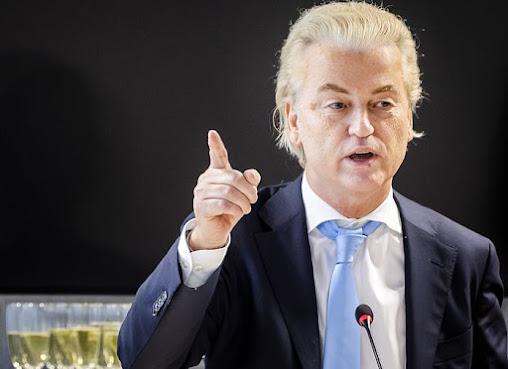
Geert Wilders following the Dutch General Election last November. Photo Credit: Remko de Waal/AFP/Getty Images.     F ellow centre-lef...